String Spacing Rule Instructions
Updated Nov 24, 2026
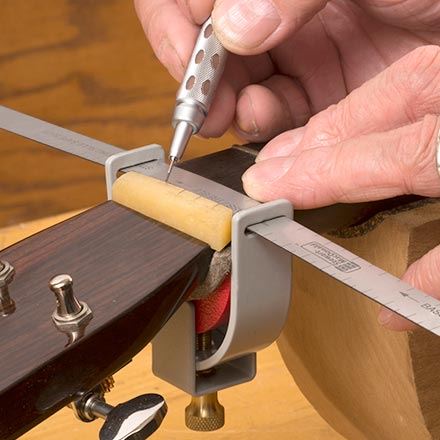
The String Spacing Rule locates string positions so that heavier strings get the wider spacing they need.
Proportional string spacing
The String Spacing Rule locates string positions so that heavier strings get the wider spacing they need. The Rule's spacing is proportional, so that each space differs from the next by exactly .004". This creates the comfortable string spacing that players expect from quality instruments.
Equal vs Proportional String Spacing
Equal spacing places every string the same distance from its neighbor, measured center to center. It looks tidy on paper, but strings aren't all the same thickness. A wound low E is noticeably fatter than a plain high E, so equal center-to-center spacing leaves less room between the actual edges of two bass strings than it does between two treble strings. Your fretting and picking hand feel that difference even when the ruler says everything's even.
Proportional spacing accounts for string gauge instead of ignoring it. Each gap widens slightly as the strings get heavier, so the space between string edges, the part your fingers actually interact with, stays consistent across the whole set. That's the spacing nearly every well-built instrument uses at the nut and saddle, and it's why the String Spacing Rule builds in a .004" increase from one space to the next rather than holding every gap identical.
The difference in practice:
- Equal spacing: same center-to-center distance for every string; bass strings end up feeling crowded against their neighbors, treble strings feel comparatively wide open
- Proportional spacing: center-to-center distance grows with string gauge; every string feels evenly spaced from the one next to it, regardless of where it sits on the neck
Once you've strung up a guitar with proportional spacing, equally spaced strings are hard to miss. They don’t look right, and they don’t feel right. Chords feel lopsided, and your fretting hand has to make tiny adjustments string to string that it shouldn't need to make at all.
Using the String Spacing Rule
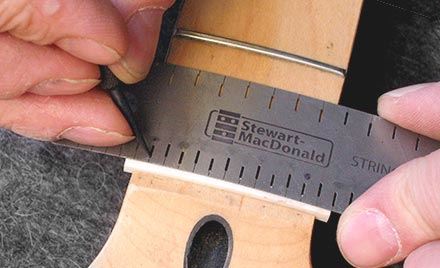
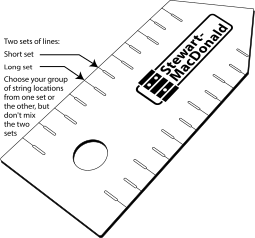
There are two sets of lines on the rule (they overlap so that one set is located in the spaces between the other). Use either long or short set of lines, but don't mix the two: choose all your string locations for one instrument from the same set. If you mix the two sets, your strings will be irregularly spaced.
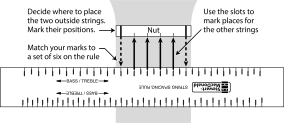
Decide where to place the two outside strings
Choose the locations for your two outer strings. (On a guitar, these would be the two "E" strings, and they're usually located about 1/8" in from the fretboard edge.) Mark these two positions on the nut or saddle.
Match your two marks to the ruler
Place the rule on the fretboard against the nut, and align any line on the rule with your mark for the treble E string.
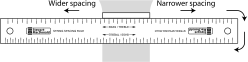
Count out six lines to the left on the rule (for a banjo or bass, count four marks). Be sure all of the lines are the same set.
Slide the rule left or right until you find the group of six lines that best matches the width of your two outside strings.
Mark places for the other strings
Use a scribe or thin mechanical pencil to mark the string positions on the nut or saddle. A scribe or razor knife creates a shallow groove which makes a good starting point for filing the string slots.
For use with the Safe Slot Nut Guard: a slim-size String Spacing Rule:
Raise the rule to the top of your nut blank using the flexible plastic shims included. Stacked feeler gauges can be used if you have a low nut, but they can be too stiff to conform to the radius of the fretboard.
Get Spacing Right the First Time
Nailing string spacing isn't about eyeballing it and hoping for the best. It's a measurable, repeatable step, and the String Spacing Rule takes the guesswork out of it whether you're cutting a nut from scratch or replacing a saddle that's never quite felt right. You choose the correct outside string spacing, and the String Spacing Rule automatically shows you the correct, proportional spacing, for each string in-between.
We've been in the workshop for over 50 years figuring out tools like this one, because a guitar that measures perfectly and still feels wrong in your hands isn't done yet. Get the spacing dialed in, and every chord your player fingers, and every note they pick, meets their hand exactly where they expect it to.
That's the kind of detail work we love talking about. If you've got questions on nut and saddle work, or you're ready to tackle your first setup, our team's always here to talk shop.